top of page

What would you rather do: read yet another long ramble about a hyper-specific, deeply niche topic that will warm only the cold, shriveled heart of a hopeless nerd - or stub your toe on a chair leg? 

The choice is obvious! Chair, brace yourself.

As much as I thrive on researching every obscure corner the history of belly dance has to offer, switching from laid-back holiday mode to the Type A academic persona you know (and tolerate) is a tall order for me - even with the help of elevated caffeine concentrations in the bloodstream. 

So, in the interest of gently easing all of us into a new year of research and learning, I’ve decided to start with a slightly different format. Chill, Dorothy - we’re not going down any rabbit holes today.

Okay, that’s probably bullshit, but I do promise the rabbit holes will not be too deep.

My primary agenda today is to introduce you to a few belly dance-specific terms that you’ve most likely heard in class or at a workshop - terms you sort of, kind of understood from context, but never actually bothered to look up to see whether your gut feeling about their meaning was correct.

What follows will be most helpful if you’re new to learning all things belly dance, especially if your focus so far has been on the kinesiology of this art form.

The terms will appear in no particular order, other than the number of times I’ve watched people’s eyes glaze over when I carelessly drop them into conversation. A couple are included purely to spare you from having to reread my earlier blog posts - this time presented in a more focused and concise manner, rather than as a long diatribe from an opinionated wanna-be scholar.

A final note: we all have our preferred ways of transliterating non-English words. Serious academics and researchers aim for phonetic precision. I, being neither, aim for whatever makes sense to me personally - meaning I can actually remember how to spell it without having to Google it every single time. I’m also wildly inconsistent and feel no obligation to commit to one way of spelling. Consider it a sprinkling of spice on an otherwise bland reading menu.

Down we go! 

First on the list is awalem. This is the plural of almah - commonly rendered as almeh in early Orientalist literature. The literal translation is deceptively simple: “a learned woman.”

And this is precisely where all simplicity is going to die, because awalem is a term loaded with complexity and nuance, its meaning shifting significantly over the past couple of centuries.

“Learned woman,” in this context, does not refer to academic or scholarly training, nor does it imply expertise in the sciences. Rather, the term almah was used to describe a professional female entertainer with a broad and versatile repertoire. An almah was expected to sing, dance, play musical instruments, recite poetry, and otherwise entertain an audience. In short, she was a well-rounded performing artist.

Interestingly, according to belly dance researcher Heather D. Ward, there is currently no evidence of the term being used prior to the 18th century. This does not mean that the profession itself did not exist before then - only that the word awalem was not yet used to describe women engaged in such work.

Awalem were particularly popular among the upper classes, where they most often performed in the privacy of the women’s quarters. This allowed the women of the household to shed their modesty garments and enjoy the full performance, while the men were relegated to listening from behind a moucharabiya screen. There’s this whole other aspect about how women of the upper crust could watch the chaos of daily life, street performers, and random public spectacles from behind the same screen, without being dirtied by the gaze of the unwashed masses - but we won’t go there today!

There is ongoing debate about whether awalem were dancers as well as singers, or singers only. I will spare you the lengthy citations arguing both sides and instead remind you of one simple truth: nothing - and I emphasize nothing - in Egyptian history is ever cut and dry.

In short, practices varied. But for the sake of a more accurate and inclusive reflection of reality, we’ll assume that awalem were both singers and dancers.

It is important to keep in mind that, although awalem performed for the elite, they themselves did not belong to the elite class. On the contrary, they most often came from lower social strata and were perceived accordingly, despite being an indispensable part of celebrations marking all stages of life.

Events such as a sebou (a child’s seventh day of life), circumcisions, saints’ birthdays, and other major milestones could not be celebrated without the presence of professional entertainers.

The culture - or the institution, if you will - of the awalem tradition appears to have died out by the end of the 20th century, and there are no known practicing awalem in Egypt today. This decline was the result of multiple factors, the most significant of which was the 1952 revolution.

Yes, my favorite dead horse is back again!. Allow me to beat it - enthusiastically - once more: traditional entertainers did not align with the government-imposed vision of Egyptian national identity. As a result, a profession that had existed for centuries was gradually pushed into decline and ultimately erased.

The definitions have shifted yet again. Today, traditional female entertainers of the past are often held up in contrast to modern professional performers - usually by someone arguing that “belly dance has turned into gymnastics (or striptease, or whatever floats their angry little boat), that it’s too sexual, too revealing, too vulgar, blah blah blah… unlike the modest, proper awalem of the good old days.”

Well, Dorothy, I trust you know better by now.

In conclusion, awalem can be defined as skilled professional female entertainers who primarily worked in private, high-class, gender-segregated settings.

This segues beautifully into the next item on the list: ghawazi. Surely you’ve heard the term before - most likely delivered with a tremble in the voice, along the lines of: “Khayriya Mazin is the very last practicing ghawazi left on this planet. When she dies, the art of ghawazi will perish forever.” Cue ominous violin music.

To understand why this claim is… let’s say deeply weird, we first need to clarify what ghawazi is not

It is not a tribe. It is not an ethnicity. It is not a religious sect.

Ghawazi is the plural of ghaziya (female) or ghazi (male). Since we’re focusing on women here, I’ll stick with ghaziya for the singular.

Despite what 19th-century Orientalist writers - and, regrettably, some much more recent authors - would have you believe, ghawazi describes a multi-ethnic profession, not a monolithic cultural group.

Now, a necessary warning label. In Western dance circles, ghawazi is usually treated as a neutral - or even romanticized - term. In Egypt, not so much. There, it functions more or less as an insult, and for very specific reasons: historically, ghawazi occupied the lowest social strata of Egyptian society. They were poor, marginalised, and socially stigmatised - yet somehow indispensable. Just like the awalem. 

So, what are ghawazi? I will shamelessly repeat myself and say they are professional female entertainers with a broad and versatile repertoire.

“But how are they different from the awalem?” you might ask, dear Dorothy. Oh, I’m glad you did, because the differences are real - and not remotely trivial.

While awalem primarily performed in private, elite, gender-segregated settings, ghawazi worked very much in the public eye. They sang, danced, and played drums in the streets, performing for mixed, unsegregated crowds of all genders and low social classes. Because ghawazi mostly performed in public spaces, they were visible to anyone who happened to be present. It is therefore inaccurate to claim that they never entertained members of the upper classes. Social status does not confer invisibility, and elites, much like everyone else, occasionally found themselves on the same streets, squares, and festival grounds as everyone they publicly pretended not to notice. 

Another key difference lies in how women ended up in these professions in the first place. Most awalem appear to have entered professional entertainment from outside established performer families - very likely due to good old-fashioned financial insecurity. While it is not entirely impossible that a young Egyptian girl awoke one morning and thought, “You know what sounds fun? To be a professional entertainer when I grow up, because nothing screams life goals like being widely assumed to be a normative-gender-role-bending harlot and general moral menace,” such a scenario seems… unlikely. Possible? Sure. Probable? Let’s not insult statistics.

By contrast, ghawazi were far more commonly embedded within familial and hereditary performing networks. Profession, reputation, and social status were transmitted intergenerationally, making entry less a matter of individual choice than of birth and kinship. It turns out that escaping a “disreputable reputation” is much harder than simply marrying someone who already shares it.

In short, while awalem often entered the profession through circumstance, ghawazi inherited it wholesale - along with the music, the movement, and a social standing so low it practically came with a basement suite.

As time went on and the distinctions outlined above became less pronounced, a new internal division emerged within the broader category of traditional female entertainers. Awalem increasingly came to be associated with performances in urban centres, while ghawazi were more commonly linked to rural settings. Despite this geographic differentiation, both groups continued to fulfil the same essential social functions they had for centuries: serving as indispensable participants in life-cycle and communal celebrations, including weddings, mawalid, circumcisions, and other festive occasions.

The labels became imprecise, the settings evolved, but the work itself - necessary, marginal, and structurally unchanged - remained remarkably consistent.

An important note on geographical distinctions within ghawazi performance traditions: there are clear stylistic differences between Upper Egyptian ghawazi and their Delta counterparts. These differences extend well beyond musicality and costuming, but a detailed discussion of them falls outside the scope of this post.

It is worth keeping in mind that Khayriya Mazin represents an Upper Egyptian ghawazi style, filtered through her own personal and familial Mazin lineage. So please - before you run with it - do the research and consult multiple sources. And if you choose to style your performance after any ghawazi artist, proceed with both caution and respect.

Moving on.

Zeffa (singular) and zeffat (plural) refer to a parade or ceremonial procession. Zeffa al Aroussa is the bridal procession. During a wedding celebration, the bride and groom are escorted from the bride’s parental home - where she grew up - to her new home, the one she will now share with her husband.

In modern contexts, this may look like a procession down a hotel hallway into the reception area, or perhaps a grand loop around a room packed with guests. Traditionally, however, the procession took place in the streets and included musicians and other professional entertainers. It was not uncommon for a zeffa to feature more than one dancer; increasingly elaborate zeffat became a point of neighborhood bragging rights and a competitive exercise in ceremonial dick-measuring among neighbors.

Although the Zeffa al Aroussa is ostensibly all about the bride, it is the dancer - or dancers - who lead the way, sometimes with a lit candelabrum balanced on their heads. 

Yes, Dorothy, this is how raqs el shamadan entered the narrative. Cue yet another “it’s a myth but honestly, who even cares anymore?” eyeroll. 

Quick note: there is a Zeffa 4/4 rhythm. It goes something like Doum-tek-ka-tek-tek, Doum-tek-tek and has a beautiful, ceremonial feel.

And while we’re at it, let’s talk about the next word on the list - shamadan. A shamadan is a candelabrum - or a candelabra. Since I genuinely do not know which term more properly applies to the large candle holder in question, feel free to pick your preferred linguistic hill to die on. English isn’t my first language, after all - yes, I’m absolutely playing my get out of jail free card here.

Shamadans for dancing can be either free-standing or mounted on a specially made, helmet-like base that is supposed to help balance the metal motherfucker on your head. Allow me to burst that bubble using lived experience: unless you add ties that go behind the head (artfully - or not -  concealed under your hair) or a chin strap, the helmet does very little to help. What it does provide is a false sense of security. Credit where credit is due!

In practice, a well-balanced free-standing shamadan is almost always easier to dance with than an unbalanced candleholder attached to a migraine-inducing head cage masquerading as “support.” One relies on physics and skill; the other relies on vibes and misplaced optimism. That said… if I had to choose between balancing a crappy helmet-based shamadan or never experiencing the thrill of dancing with a shamadan at all, I’d always pick the former. But, as always, you do you!

And now, after I’ve pontificated at length on some of the notoriously misunderstood terminology of Egyptian belly dance, let’s wrap things up with a gentle reminder of the alternative name we often use for this delightful art form: raqs sharqi.

Raqs” simply means dance, while “sharqi” translates as eastern or of the east. Crucially, this refers to the Eastern Arab world, not the fuzzy Orientalist notion of “everything east of Europe.” And while we’re at it, let’s throw raqs baladi into the mix for good measure. “Baladi” literally means of the country or of the homeland. In practice, it most commonly refers to the social form of dance related to raqs sharqi - danced by people of all ages and all genders at celebrations, gatherings, and life events.

Hopefully, this quick run-down ahead of the new season of dance classes will help you approach it with a bit more enthusiasm - and, more importantly, with a greater appreciation for nuance.

I’ll leave you with two final thoughts.

First: several of the topics that came up today have been explored in far more detail elsewhere in my writing. One dives into the history and origins of the term “belly dance” itself; another unpacks raqs el shamadan; and yet another gleefully dismantles the endlessly recycled myth of who supposedly gets credit for being the very first shamadan dancer. Those who seek, shall find. It’s all out there somewhere.

Second - and this one is non-negotiable - nothing in the history of raqs sharqi is defined by impermeable borders. Whenever you hear someone proclaim, “Dancers never, ever did this,” or “Egyptians always did that,” pause. Question their sources. Raise an eyebrow. Maybe raise both. And if someone confidently insists that “awalem always did things this way and this way only,” feel entirely free to disengage from that conversation altogether - there was never a strict, universally enforced rulebook that all awalem obediently followed.

Egyptian history is a landscape of fuzzy boundaries, overlaps, contradictions, and exceptions. If there was ever a single rule that was consistently applied and widely followed, it would be this one: the rule of bending the rules.

For a full list of sources used to compile this little dictionary of terms, to express your disagreement with anything I’ve said, or simply to point out the difference between a candelabrum and a candelabra, feel free to get in touch. askauntiehelen@gmail.com


What’s your favorite winter holiday beverage?


Does the mere mention of eggnog, hot chocolate, or a peppermint mocha instantly conjure that festive spirit and celebratory mood? I know what you’re thinking, Dorothy - gin is a drink for all seasons, but let us attempt - however half-heartedly - to keep things marginally more liver-friendly before the New Year’s Eve champagne unceremoniously escorts us into the first of January.

No matter how earnestly I try to fall in love with the seasonal parade of beverages - each one promising warmth, comfort, and a fleeting sense of festivity - I inevitably come crawling back to one faithful companion. My reliable, trustworthy sidekick; my daily fuel; and, on certain mornings, the only reason I pry myself out of bed at all: coffee. I like mine black and strong, though I will, on rare and diplomatic occasions, settle for a latte. 

The most famous perk of coffee - caffeine - is a psychoactive substance beloved across the globe. It works its magic on the human central nervous system, giving us that delicious jolt of alertness, and is officially classified as a stimulant. Ah, what a grim and joyless world it would be if it weren’t for this marvelous mood-altering elixir!


Great! But what does any of this have to do with what we now call belly dance? 

Well, in true raqs sharqi fashion, the answer is - of course - complicated.


Coffee has a centuries-old presence in MENAHT regions, Egypt included. Egyptians were introduced to coffee during the Ottoman conquest in the early 1500s, and it didn’t take long for the drink to sweep through Cairo - but not without a controversy. 

This article examines the debate surrounding coffee’s status in the early 16th century - specifically whether it should be regarded as halal (permissible) or classified as khamr (mind-altering or intoxicating). Thankfully, the pro-coffee group of the time prevailed, and the vast majority of modern Islamic scholars do not consider coffee a prohibited substance when consumed in moderation.


It’s all well and good, but naturally the controversy didn’t stop with the beverage itself - because when has anything in Cairo’s history ever been that simple? 

Coffeehouses became a phenomenon in their own right, and some of the very scholars who had deemed coffee permissible for law-abiding Muslims weren’t quite as approving of the “coffeehouse culture” that quickly took hold.

As elsewhere in the Ottoman Empire, venues serving coffee for in-house consumption became social hubs, mostly frequented by local men. 

These coffeehouses became a caffeine-fueled headquarters for discussion, open dialogue, and challenges to class structures and power dynamics. You could even call coffeehouses the original “freethinkers’ clubs” - sort of like your local pub, but with fewer hangovers. 

Moreover, as in many environments where oral transmission is the primary mode of information exchange, coffeehouses developed into important nodes of social and professional networking among their regulars. They also functioned as informal labor markets for artists and performers. For instance, an individual preparing for a family wedding might visit a coffeehouse known to serve as a gathering place for musicians, dancers, jugglers, and other traditional entertainers, thereby securing the necessary performers for the forthcoming celebration.

To further elaborate, I must introduce a term you might not have encountered before: heterotopia, or heterotopic spaces. This Wiki page covers the basics you’ll need and offers a few examples to help you grasp the concept.


So, Egypt has long maintained a curious tradition of blending the sacred and the secular within specific temporal and spatial contexts. 

At different times in its long history, Cairo was divided along geographic lines that neatly reflected socioeconomic hierarchies: the southern suburbs were the playground of the upper class, while the western suburbs were home to commoners and, shall we say, society’s more colorful characters. Areas near ponds and canals might have occasionally hosted the elites, though the day-to-day residents were firmly from the lower classes. Shrines and cemeteries, too, functioned as what we might call heterotopic spaces, where individuals from markedly different social strata inevitably mingled. Nothing brings a community together quite like reverence, ritual, and the occasional burial plot!


Sidenote: The religious shrines and cemeteries of Mamluk, Fatimid, and Ottoman Egypt are not exactly what one might describe as havens of quiet reflection we imagine today. Far from spaces of solemn contemplation, these sites frequently erupted into joyous, uninhibited celebrations of life - festivals for the living in all their unapologetically carnal glory. I may or may not devote an entire future blog post to the wonderfully unrestrained shenanigans that were, at certain points in history, entirely routine.


During mawalid, festivals commemorating saints, this mixing of worlds was not merely tolerated; it was expected - a rare occasion when Cairo’s social rigidities relaxed enough to allow the upper crust and the riffraff to be equally present. 

But these occasions had one particularly striking feature: the usual power dynamics were turned on their head. After centuries of living under one “flavor” of occupation or another, Egyptian natives remained markedly distinct from their various rulers - ethnically, socially, politically, and economically. Yet it was precisely within these celebratory heterotopic spaces and events, where boundaries bent and blurred in every direction, that Egyptians could temporarily invert the established hierarchy and assert control while maintaining a strong sense of self-identity. As you can imagine, the elites of the occupying powers were… less than enthused by this development.

It was within these rule-bending, gender-norm-disturbing spaces that professional entertainers were in their element. 

As I’ve noted more times than is probably polite, the very nature of their profession positioned them in conflict with prevailing societal values, which simultaneously stigmatized them as disreputable and depended on them for essential communal functions. Festivals such as mawalid and wedding celebrations were, in practice, inconceivable without dancers and musicians.


And this is where it all comes together. 

The coffeehouses - now functioning as networking hubs and informal hiring markets - were filled with individuals of ambiguous, liminal social status. In doing so, these cafés themselves turned into mini heterotopias: places where the rules were a little fuzzy, hierarchies were politely ignored, and anything that could be bent… probably was.


We have numerous written accounts of dancers performing in such venues, as documented by European travelers of the 19th century. I’ll spare you the long quotes, but I encourage you to revisit my rant, S#!t Orientalists Say…”, which cites several examples of ghawazi entertainers performing in cafés or coffeehouses. And yes, that doesn’t even begin to cover the surviving Ottoman accounts of similar performances. Clearly, professional entertainers were as much a part of the coffeehouse scene as the beverage itself.

As entertainment halls began to emerge, coffeehouse performances didn’t suddenly vanish. They may not have been as polished or structured as shows in salons or music halls,  but they remained a vital component of the entertainment landscape across urban centers in Egypt, not just in Cairo.

Even at the height of the Golden Era of Egyptian cinema, these heterotopic spaces didn’t lose their original function as hiring hubs. Musicians, dancers, and other performers would congregate at coffeehouses in the afternoon, hoping to land a gig at a wedding or other celebratory event. Potential clients came to book a date, negotiate a price, or request references if their performer of choice was otherwise engaged. With the advent of the telephone, these practices became even more convenient - clients could leave a message with the coffeehouse staff, detailing their requirements.

The centuries-old subculture of the coffeehouses persisted well into the 20th century, seemingly fading only alongside the collapse of the awalem tradition in the 1990s. While coffee itself remains a beloved staple for many Egyptians, the cafés and coffeehouses are no longer quite what they once were. Back in the day, these places were equal parts caffeine hub, gossip HQ, and freelance audition stage for dancers and musicians - where professional entertainers could network, show off, and bend the social rules by the mere fact of their existence. Still, one thing hasn’t changed: cafés remain perfect spots to shoot shit, argue about ideas, and nerd out with friends. Maybe plan a revolution. Because honestly, where else are you going to do that with a cup of strong coffee in hand?

If this post proves anything, it’s that Egyptian entertainment and society are so intertwined that even coffee can’t escape its belly dance roots. So next time you sip that java, pause for a moment. You’re not just studying a dance form - you’re walking the line between worlds like the liminal badass you are.

Have something to add? Get in touch: askauntiehelen@gmail.com


A fellow dance student recently asked me if it would be OK to dress up as a belly dancer for a Halloween party. 

I couldn’t give her a straight ‘yes’ or ‘no,’ so I launched into my usual evasive verbal maneuvers - namely, asking her what exactly she meant by ‘dressing up as a belly dancer’. Because nothing quite declares “I am a hopelessly committed nerd” like delivering an hour-long lecture on the evolution of belly dance costuming! 


Unless you’ve been immersed in the world of raqs sharqi and its many controversies for years - chief among them the dramatic, ‘The costumes became too revealing, too sexy, too scandalous!’ - then when you picture a belly dance costume, you’re probably imagining a heavily decorated hip sash and a bra-like top with matching embellishments, and a flowy skirt. 

It’s a very recognizable image - so much so that we collectively treat this belly dance getup as a sort of professional uniform. We’ve even gone so far as to appropriate an Arabic term for it, just to streamline communication and, of course, make ourselves sound a little more ‘in the know.’


The word bedlah (sometimes anglicized as badlah) simply means ‘suit’ in Arabic and can refer to any such outfit - including a man’s tailored suit.

There’s something deliciously ironic about a word that can describe a funeral attire being equally applicable to a shiny bundle of sequins, fringe, and strategic double-sided tape!


Unless you dance strictly theatrical folklore, chances are you either own a bedlah (or twelve) - or have at least worn one on stage. The bedlah has been a staple of raqs sharqi costuming for ages… or has it?


Let’s tumble down a historical rabbit hole, Dorothy, and take a gander at what existed before the bedlah stole all the glittery attention.

I’m setting our free-fall destination in the first half of the 19th century. Partly because I want to show you a quote that sets the stage for what’s to come - and partly because, frankly, my knowledge of Egyptian belly dance history doesn’t stretch much further back than that. The French occupation of Egypt in the late 18th century did leave behind some historical records relevant to today’s topic, but I’ll leave the joy of digging through those early Orientalist accounts to you - as homework. You’re welcome.


“68 Dancers The almées are generally young and pretty women; they are both artists and courtesans. Their costume is almost the same as that worn by the elegant ladies of the country and which we have already described, but it is imbued with this particular character which everywhere distinguishes the exterior of the gallant woman from that of the honest lady. Thus their clothes tighten and outline the forms more; their throat is uncovered; their arms are bare; there is in their adornment the search for the most precious fabrics, affectation of wealth, profusion of gold and jewels.” (Clot-Bey, A.B. 1840. Aperçu Général sur L’Égypte. Tome Deuxième. Paris: Fortin, Masson et Cie.***Translated by Google) 


It’s quite clear that, at the time of Clot-Bey’s writing, professional dancers did not wear a badlah or anything resembling it. Their “costuming” consisted of the everyday attire of middle- and upper-class Egyptian women. Of course, some modifications to dancers’ “costume” were inevitable - necessary, even - to enhance the performance and highlight the carnal nature of their art.

The key difference was that “honest ladies” would always wear a modesty garment - such as a thobe and a bur’a - over their regular clothing when appearing in public spaces.


So, what did women not involved in professional entertainment wear in Egypt at that time? Fashion among the general populace closely followed the trends set by the Turkish-Ottoman elite and was largely indistinguishable from styles seen throughout the vast Ottoman Empire. 

Let’s make a list of clothing items typical of middle- and upper-class Egyptian women. 

For more detailed descriptions - including fabric types, colors, and how these varied by socioeconomic status - I highly recommend reading Edward William Lane’s chapter “Personal Characteristics, and Dress, of the Muslim Egyptians” in its entirety. We're focusing primarily on the section describing women’s clothing, which begins on page 41. It’s far too long (and detailed) to quote here in full, but well worth the read.

  • Chemise or undershirt: typically made of gauzy, lightweight, and often sheer fabric. By the mid-19th century, it had shortened to about knee length; however, earlier records indicate that undershirts were considerably longer in previous decades.

  • Yelek: made of a more structured fabric, this garment is fitted to the waist with side slits below the waistline. Although it buttons down the front, it still reveals much of the chemise-covered bosom underneath. Typically floor-length, it could even extend a few inches beyond that.

  • ‘Antaree: essentially the upper half of the yelek - a fitted, long-sleeved, jacket-like garment that extends only to the waist.

  • Shintiyan: better known to modern-day dancers as pantaloons — very wide-legged, billowy trousers. The bottoms were tied just below the knee yet were long enough to drape to the floor or at least reach the feet.

  • Shawl: most commonly a square piece of cashmere, or other fine wool fabric, folded diagonally in half and wrapped loosely around the waist.

  • Sudayri: a short vest worn between the undershirt and the yelek (or antaree) during cooler weather, such as in the winter months. Keep this garment in mind - it will become a prominent feature of belly dance costuming in the latter half of the 19th century and beyond.

Not included in this list for the sake of brevity - but still worth mentioning - are shoes, headwear, jewelry (including amulet boxes), hair adornments and hairstyles, modesty garments, and, of course, tattoos.

So, if you’re struggling to piece it all together and imagine a professional entertainer from this era, here’s a handy visual aid: Egyptian Dancing Girls by Luigi Mayer (aquatint, 1802)


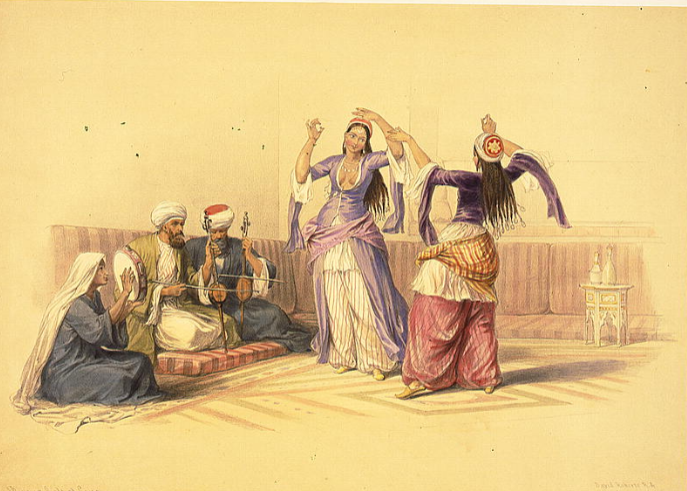
In this drawing by David Roberts, Dancing Girls at Cairo (1840s), the dancer on the left sports a yelek, while the one on the right rocks an antaree.


If you'd like to compare a "gallant woman" to an "honest" one, here is an illustration from E.W. Lane's book I linked above. Note the title: “A Lady in the Dress Worn in Private.”


The fashion of the Ottoman elite evolved as the 19th century progressed and so did the dancers’ professional attire. The antaree became more popular than the long yelek, and sudayri were no longer limited to winter wear but in some cases fully replaced the antaree. However, yeleks still maintained their presence in more rural settings - unsurprising, considering that the pace of fashion inevitably slows the farther one gets from the capital.

Drawn images are great, of course, but the advent of photography truly expanded our collective understanding of professional dance costuming in the mid-19th century. 

Here you can see a photograph by Ernest Benecke titled Zofia, Femme du Caire. The second photo features the same woman and is titled Zofia, Intérieur du Harem. Both shots were taken in 1853. 


If you browse through this fascinating and eclectic collection of early photographs, you’ll also find an image from a year earlier - 1852 - by the same photographer. Note that the lady smoking a hookah is wearing sheer chemise, with her sudayri and shintiyan made of matching fabric.


“But wait, Auntie,” you might say, “what makes you think those women were dancers? There’s nothing to indicate they were professional performers!” You’re absolutely right. It seems like most dancers were photographed wearing their finger cymbals, since zills were a non-negotiable part of any dance performance in earlier years.

Side note: it might just be my luck, but the majority of late-19th- to early-20th-century photos of dancers with cymbals that I stumble across on the interwebs show them holding the finger cymbals in the closed position. Makes one wonder why…Every time the Cymbal Ladies of my dance tribe strike a pose for a photo, we make sure to hold ours open - because nothing says “I suffer for my art” quite like flashing your shiny little torture devices for the camera.

Back to the question of profession. Those women could be dancers - or they could be prostitutes. Or, quite possibly, both. In the public eye of the time, the two were often indistinguishable anyway. One thing is certain, though: these women were not of high social standing. No woman of “respectable” status would have allowed herself to be photographed without her modesty garments - head covering, veil, and all.


Fast forward to the late 19th century. The following images by Gabriel Lekegian are instantly recognisable to anyone interested in the history of raqs sharqi


A great deal had changed in the preceding decades, especially in fashion. Ottoman dress had absorbed more European influences, which translated neatly into dance costuming. The undershirt, once knee-length, was now cropped at the waist; the yelek and ‘antaree were replaced entirely by the sudayri; skirts, adorned with imported lace trims, made their debut - though some dancers still preferred to wear shintiyan under a skirt rather than stockings. European-style heeled shoes became popular. 

Most notably, the diagonally folded shawl gave way to a ribbon belt. 

This marks the first recorded instance of “a special outfit just for performing” - the birth of the Egyptian dance costume. The ribbon belt had no equivalent in the everyday dress of the middle- or upper-class women of late 19th-century Egypt.

The Raqs Sharqi Museum has an outstanding collection of drawings, lithographs, etchings, and photographs from the period we’re exploring. I highly encourage you to browse through them, note the year of each piece, and trace the changes you spot from one era to the next. It’s a fascinating - if delightfully nerdy - game to play!


So here we are, at the turn of the 20th century. Do indigenous entertainers have a professional uniform? Well, sort of. Their outfits are recognized as costumes, but not to the extent that we “costume” ourselves for performances today. 

In keeping with pretty much everything else, Egyptians didn’t simply absorb all Western influences wholesale - they selectively adopted and adapted what worked for them.


Surely you’ve heard the claim that the bra-belt-skirt combo - the bedlah - was introduced by Hollywood and Western art in general. The story goes that Egyptian dancers saw how Europeans portrayed the “Orient” and adapted their costumes to please their Occidental patrons. This, however, is highly unlikely.


First, the timing is off - what we would recognize as a bedlah didn’t really emerge until the 1930s. Second, the natural evolution of belly dance attire into the bedlah was, frankly, inevitable. Look at the images above and tell me you don’t see the connection! The bust and hips are accentuated, the mid-torso exposed yet visually softened by the more striking fabrics above and below it. Those tiny, glove-tight vests kept shrinking and the sheer undershirts were eventually abandoned - only to be partly replaced later by shabaka (belly cover) to appease the censors.


It doesn’t look like Egyptian dancers were rushing to adopt those absurd “disk bras” that Western fantasy insisted were the sensual attire of mysterious Oriental dancers! 


Let’s not strip the traditional professional entertainers of MENAHT of their agency - or, worse, assume that whatever they did was simply to please their colonizers.


Every innovation in belly dance costuming that we have a historical record of seems to be a natural response to organic changes within its source culture. This was as true a century ago as it is today.

And speaking of the last century - there’s much to be said about the evolution of costuming in the early 20th century, before the glitz and glamour of the Golden Era of Egyptian cinema took center stage. I might just do a part two to explore some of the fascinating developments from that period…No promises, though, Dorothy - I value my (in)sanity far too much to commit just yet!


Think I’ve committed a historical atrocity? Consider this your official invitation to nitpick! 


Belly Dance students
bottom of page